

How to Rank in ChatGPT, Gemini, and Perplexity
Search engines are no longer the only places where people discover websites, products, and information. Many users now ask AI tools for recommendations, explanations, comparisons, and solutions. Instead of browsing ten different pages, they may receive a summarized answer with links to supporting sources.
This shift creates a new opportunity for website owners. Learning how to rank in ChatGPT, Gemini, and Perplexity can help you improve your website's chances of being discovered when AI tools answer questions related to your niche.
However, there is no guaranteed shortcut to appearing in AI-generated answers. Each platform works differently, and visibility depends on factors such as relevance, accessible content, credibility, and the sources selected for a particular query.
In this guide, you will learn practical AI SEO techniques, content optimization methods, technical checks, and ways to measure your website's visibility across these platforms.
What Does Ranking in AI Search Actually Mean?
Traditional SEO focuses on improving a website's visibility in search engine results. AI search optimization focuses on helping your content become a useful, discoverable source when AI systems generate answers.
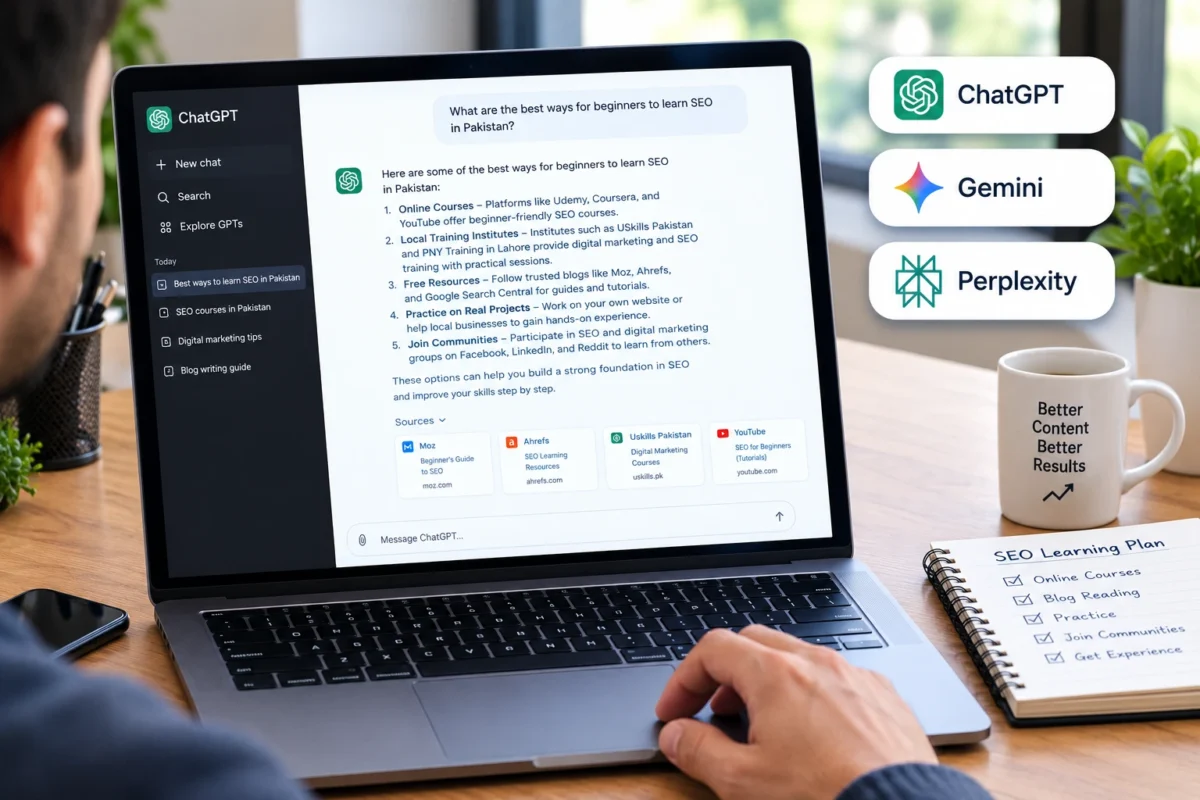
For example, imagine you publish a detailed article about learning SEO in Pakistan. Someone asks an AI tool, "What are the best ways for beginners to learn SEO?"
The tool may summarize relevant information and link to selected websites. If your content is useful, accessible, and relevant to the question, it may have an opportunity to appear as a cited source.
This approach is commonly associated with Generative Engine Optimization (GEO) and Answer Engine Optimization (AEO).
The goal is not simply to rank for a keyword. It is to publish content that deserves to be discovered, understood, and referenced.
How ChatGPT, Gemini, and Perplexity Discover Content
Although these platforms can provide similar answers, their discovery systems are not identical.
1. ChatGPT:
ChatGPT can search the web and provide answers with links to relevant sources. Website owners should ensure their public content is accessible to the appropriate search crawler, known as OAI-SearchBot.
ChatGPT does not guarantee a particular position or citation for any website. Its results can vary according to the user's question and the information retrieved.
2. Google Gemini:
Google's AI experiences are connected to Google's search ecosystem. Google's published guidance explains that established SEO practices remain important for its AI search features.
This means website owners should continue to focus on useful content, crawlability, indexing, internal links, and a strong overall website experience rather than relying on supposed AI-specific ranking tricks.
3. Perplexity:
Perplexity provides conversational answers that can include citations and links to sources. Making relevant pages accessible and publishing information that directly answers users' questions can help your website compete for visibility.
Do not assume that a page appearing in Google will automatically be cited by Perplexity or ChatGPT. Each platform can select different sources.
1. Create Helpful Content That Directly Answers Questions
The foundation of AI SEO is content that genuinely solves a reader's problem.
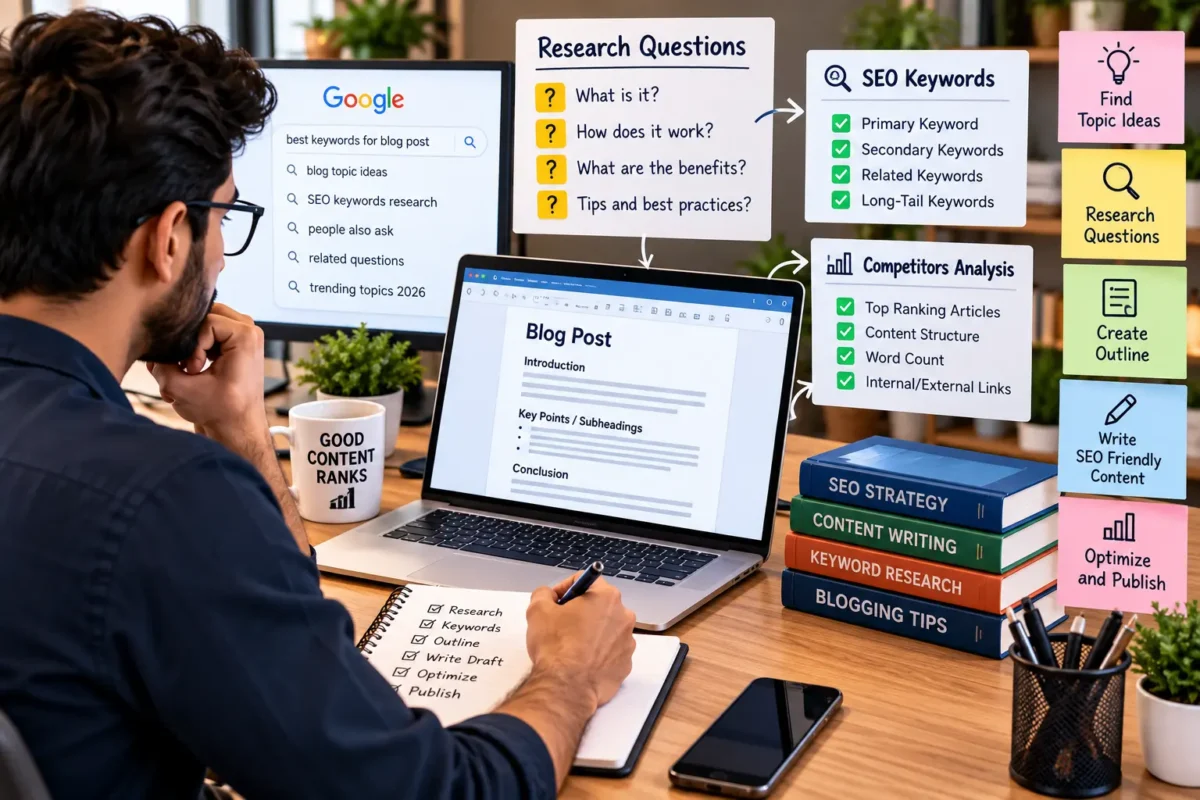
A common mistake is creating articles around keywords without answering the questions behind them. AI search users often ask complete questions, request comparisons, or look for step-by-step instructions.
For example, instead of publishing a vague article titled "SEO Tips," consider a more specific topic:
"How to Improve Website SEO for Beginners: A Step-by-Step Guide"
A useful article could explain:
- How to identify relevant search terms.
- How to improve titles and headings.
- How to write useful page descriptions.
- How to fix common technical SEO problems.
- How to measure results using available analytics tools.
Begin each major section with a clear answer before expanding on the details. This makes your article easier for readers to navigate and helps communicate its purpose.
Avoid adding unnecessary paragraphs just to make an article longer. A focused, complete answer is more useful than a lengthy page filled with repetition.
2. Use Clear Headings and a Logical Content Structure
Well-organized content makes it easier for people to find information. It also gives search systems clearer context about the subjects covered on a page.
Use one descriptive H1 heading, followed by relevant H2 headings and H3 subheadings.
For example:
- H1: How to Rank in ChatGPT, Gemini, and Perplexity
- H2: How AI Search Platforms Discover Websites
- H2: Best Content Strategies for AI Search Visibility
- H3: Write Direct Answers
- H3: Add Original Examples
- H2: Technical SEO Checks for AI Search
Keep paragraphs focused on one idea. Use numbered instructions for processes, bullet points for lists, and tables when comparing options.
You can also include a short summary near the beginning of a detailed article. This helps readers understand what they will learn before reading the complete explanation.
Important: Clear formatting is a useful publishing practice, not a guarantee of AI citations. There is no need to break every paragraph into artificial chunks solely to satisfy an AI algorithm.
3. Strengthen Your Website's Technical SEO
Even excellent content may struggle to gain visibility if search systems cannot access it or if important pages are not indexed.
Review the following technical elements.
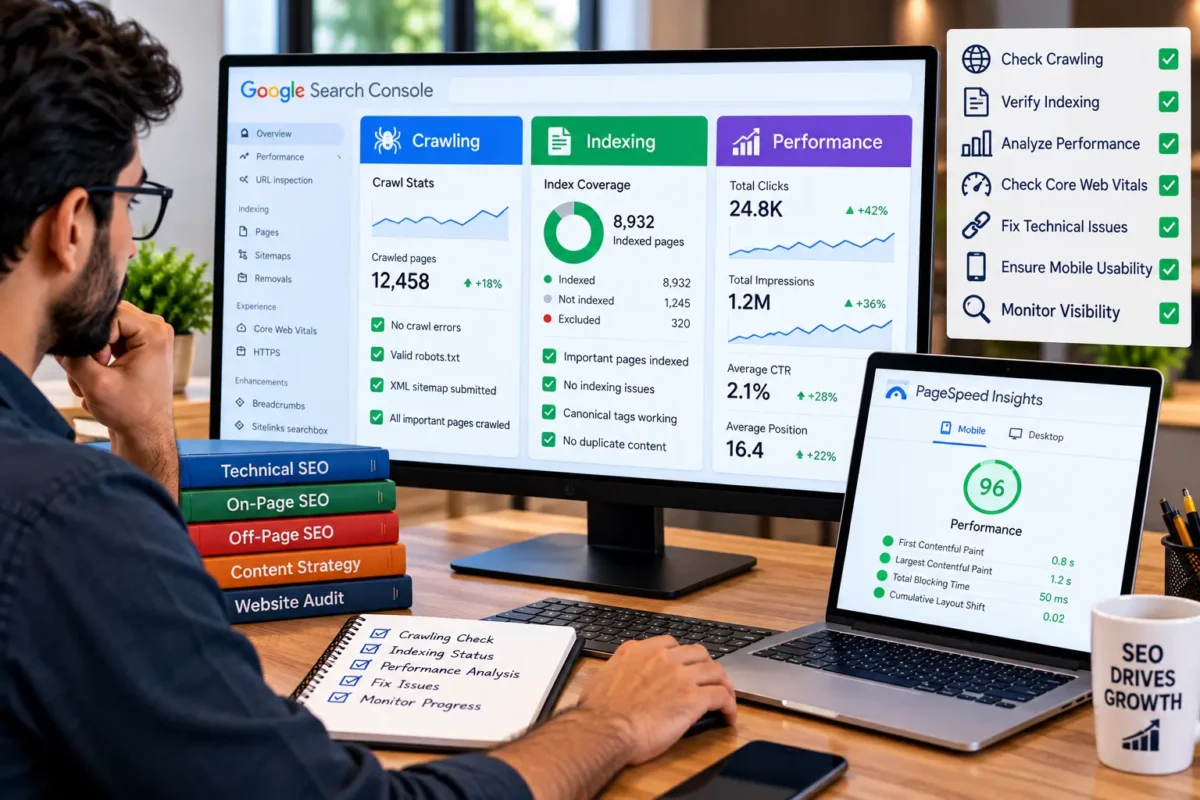
Make important pages crawlable: Check your website's robots.txt file, security settings, hosting configuration, and content delivery network. These should not unintentionally block legitimate search crawlers.
For ChatGPT search visibility, check whether OAI-SearchBot can access the pages you want to make discoverable. Follow the official OpenAI crawler documentation for the current requirements.
Check indexing: Use Google Search Console to identify indexing problems and inspect important URLs. Confirm that pages intended for search visibility are not accidentally marked noindex.
Remember that allowing crawling does not guarantee indexing, and indexing does not guarantee that an AI platform will cite a page.
Improve page experience: Make your website easy to use on mobile devices. Fix broken links, remove intrusive pop-ups, improve navigation, and address unnecessarily slow page loads.
Keep important information available as text: Do not place all essential information inside images, videos, or inaccessible interactive elements. Provide readable text that explains your products, services, instructions, and key findings.
These fundamentals improve accessibility and support broader search visibility.
4. Build Trust With Experience, Expertise, and Reliable Sources
AI-generated answers need useful sources, so credibility should be a central part of your publishing strategy.
Your website should demonstrate why readers can trust the information it provides.
Here are practical ways to strengthen credibility:
- Identify the author: Include a relevant author biography and explain their experience.
- Use reliable references: Link to official documentation, primary research, and reputable organizations where appropriate.
- Show original work: Include your own tests, examples, screenshots, observations, or case studies when available.
- Update outdated content: Review facts, links, software instructions, and recommendations periodically.
- Correct mistakes: Make corrections when information changes or an earlier explanation proves inaccurate.
- Be transparent: Distinguish verified facts from personal opinions and recommendations.
For instance, an article about WordPress SEO becomes more valuable when it includes a real configuration example, explains why a setting matters, and identifies common errors.
Do not invent author credentials, customer testimonials, research results, or case studies. Trust cannot be established through unsupported claims.
5. Optimize for Conversational and Long-Tail Keywords
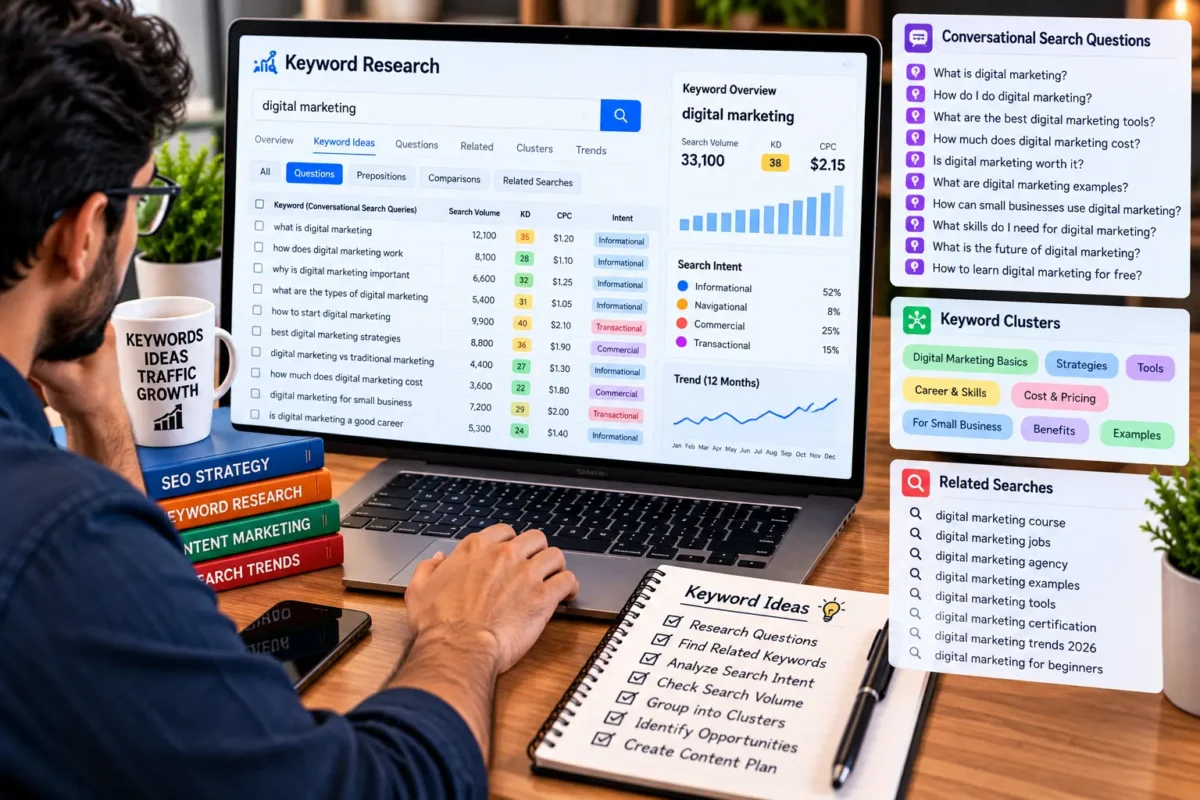
People often interact with AI tools using natural language. Their questions may be longer and more specific than traditional search keywords.
For this reason, explore the different ways your audience describes the same problem.
For an SEO website, relevant queries might include:
- How can I improve my website's visibility in ChatGPT?
- How does Gemini find websites for AI-generated answers?
- How can I get my content cited by Perplexity?
- What is the difference between GEO and traditional SEO?
- How can beginners optimize content for AI search?
Use these questions as inspiration for headings, FAQs, and supporting articles where they fit the topic naturally.
Do not create a separate page for every minor variation of the same question. Instead, combine closely related questions into comprehensive resources and create separate pages only when the search intent genuinely differs.
For a website such as uskills.pk, a useful content cluster might include an introductory SEO guide, a technical SEO tutorial, a GEO beginner's guide, and a practical article about monitoring AI search visibility.
Each page should offer distinct value and link naturally to related resources.
6. Make Your Content Easy to Understand and Reference
Readers should not need to interpret complicated wording to find the answer they need.
Use direct language, explain technical terms, and support important recommendations with relevant evidence.
For example, compare these two approaches:
Vague explanation: "Businesses should adopt a comprehensive digital strategy to improve online performance."
Useful explanation: "Review your main landing pages, identify the questions potential customers ask, and rewrite unclear sections so visitors can understand your services and next steps."
The second example communicates specific actions.
You can make your articles more useful by including:
- Definitions of important terms.
- Step-by-step instructions.
- Original examples and calculations.
- Comparisons with clear criteria.
- Pros and cons where appropriate.
- Sources for factual claims.
- Practical conclusions and next steps.
Use structured data where it accurately describes the visible content and follows search engine guidelines. Schema markup can help eligible search systems interpret certain page details, but it does not guarantee an AI citation or a higher ranking.
7. Earn Relevant Mentions and Quality Backlinks
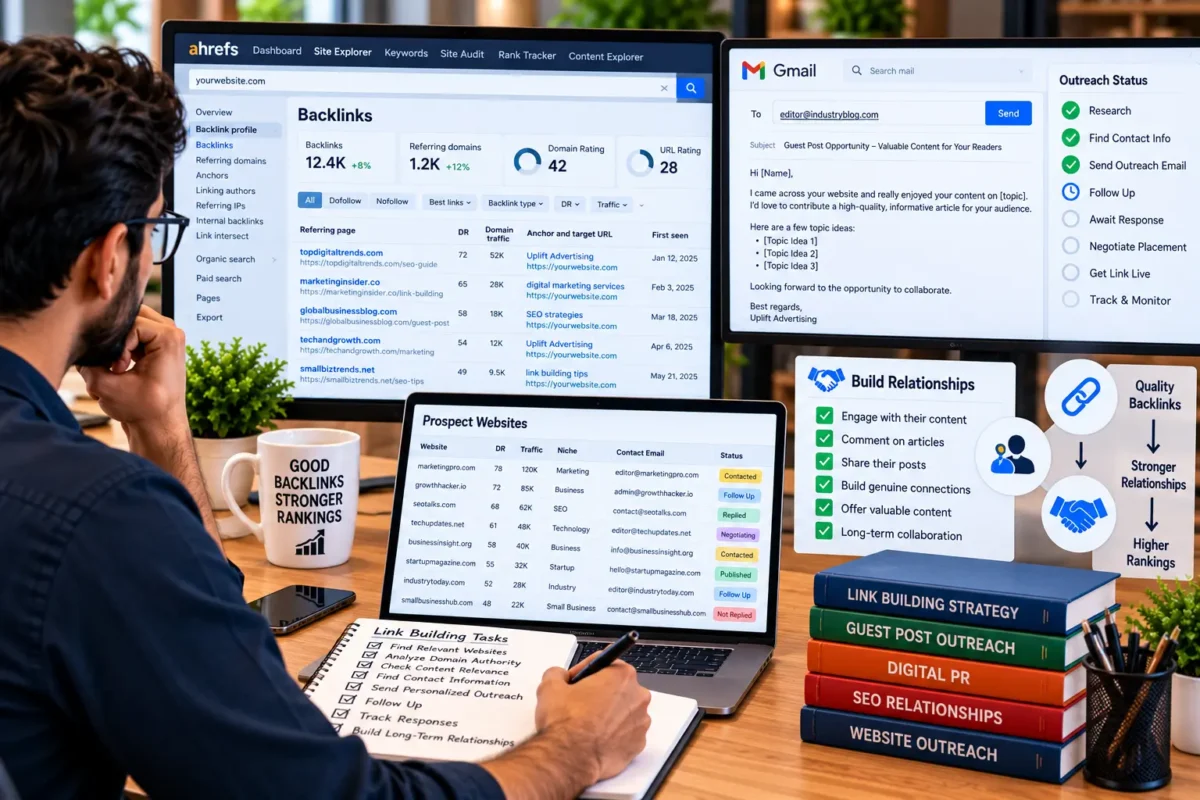
Your website does not exist in isolation. Relevant links and mentions can help people discover your work and may contribute to your broader search presence.
Focus on earning genuine recognition rather than producing large quantities of low-quality links.
Useful approaches include:
- Publish original resources that other websites have a reason to reference.
- Contribute expert commentary or useful articles to relevant publications.
- Share research, templates, and practical tutorials with your professional community.
- Build relationships with reputable websites in your industry.
- Maintain consistent, accurate business information across relevant public profiles.
Avoid buying spam links, publishing fake reviews, or creating artificial mentions purely to manipulate AI answers.
There is no reliable universal formula that converts a certain number of backlinks or brand mentions into AI citations. Treat these activities as part of a broader strategy to build reputation, reach, and useful referral traffic.
8. Use Different Checks for Each AI Platform
A single SEO checklist is useful, but each platform needs to be evaluated on its own terms.
ChatGPT visibility checklist:
- Confirm that OAI-SearchBot is not unintentionally blocked.
- Check whether key pages are publicly accessible.
- Test relevant questions using ChatGPT search.
- Record whether your website is cited and which page is referenced.
- Review whether the cited page actually answers the question.
Gemini visibility checklist:
- Check indexing and crawl issues in Google Search Console.
- Follow Google's established Search Essentials and AI-feature guidance.
- Review relevant queries in Google Search, including eligible AI search features.
- Improve pages that are thin, outdated, difficult to navigate, or poorly supported.
- Monitor changes over time rather than relying on a single test.
Perplexity visibility checklist:
- Confirm that your content can be accessed by the platform under its current crawler and access policies.
- Test questions related to your main topics.
- Note which sources are cited and what those pages contribute to the answer.
- Review whether your content contains useful information missing from competing resources.
- Repeat tests with different natural-language questions.
The same website can appear on one platform and remain absent from another. This is not necessarily evidence that something is broken; the platforms may retrieve different sources for different queries.
9. Measure AI Search Visibility Instead of Guessing
Publishing an article is only the beginning. You need a repeatable process to understand whether your efforts are helping.
Create a simple spreadsheet with columns for:
Metric | What to record |
Test question | The exact question asked |
Platform | ChatGPT, Gemini, or Perplexity |
Date tested | When the check was performed |
Website cited | Yes, no, or partially |
Cited URL | The specific page referenced |
Competitor sources | Relevant alternative sources |
Next action | The improvement to investigate |
Choose a manageable set of questions related to your most important pages. Test them periodically and keep the prompts consistent when comparing results.
AI responses may change between sessions, so one successful citation does not establish a stable ranking.
Also review traditional indicators such as organic clicks, impressions, engaged visits, conversions, and referral traffic where those measurements are available. Google Search Console and your website analytics platform can help identify broader search performance trends.
The purpose is to identify patterns and opportunities, not to claim certainty from a small sample.
Common AI SEO Mistakes to Avoid
Several misconceptions can waste time and weaken a website's content strategy.
Mistake 1: Believing one trick guarantees AI rankings: There is no universally proven prompt, keyword density, or formatting trick that guarantees inclusion in ChatGPT, Gemini, or Perplexity.
Mistake 2: Publishing large volumes of generic AI content: Using AI tools to help with research or drafting is not automatically a problem. Publishing many pages with little original value, however, can create quality and search-policy concerns.
Edit carefully, verify claims, add meaningful expertise, and remove repetitive material.
Mistake 3: Ignoring traditional SEO: AI search optimization does not eliminate the need for crawlable pages, useful content, descriptive titles, internal links, and sound technical foundations.
Mistake 4: Treating every AI answer as accurate: AI responses can contain mistakes, outdated information, and incomplete citations. Check sources before repeating their claims.
Mistake 5: Measuring success only by citations: A citation is useful, but it is not the only measure of success. Relevant traffic, useful engagement, qualified enquiries, and reader satisfaction matter too.
Key Takeaways
- Publish original, accurate, helpful content that answers real questions.
- Organize articles with descriptive headings and focused paragraphs.
- Check crawling, indexing, mobile usability, and page accessibility.
- Allow the appropriate crawlers when you want your public pages to be discoverable.
- Support important claims with reliable sources and genuine expertise.
- Use natural-language questions to guide content planning.
- Earn relevant mentions through useful work rather than manipulative tactics.
- Test each platform separately and track changes over time.
- Continue applying established SEO practices alongside AI search optimization.
Frequently Asked Questions
1. How can I rank my website in ChatGPT?
Make sure your important pages are publicly accessible and that OAI-SearchBot is not blocked if you want to appear in ChatGPT search results. Publish accurate, useful content that answers relevant questions, maintain good technical SEO, and test whether ChatGPT cites your pages. Inclusion and placement are not guaranteed.
2. How do I get my website recommended by Gemini?
Start with Google’s established SEO fundamentals. Ensure your pages can be crawled and indexed, provide original and relevant information, use descriptive headings, and maintain helpful internal links. Monitor your website through Google Search Console and review relevant AI search results. Following these practices improves your foundation but does not guarantee a recommendation.
3. How can I get my content cited by Perplexity?
Create content that answers a specific question clearly and supports important claims with trustworthy evidence. Keep pages accessible, current, and easy to navigate. Test relevant questions in Perplexity and record which pages receive citations. There is no guaranteed method for securing a citation, and results can vary between questions.
4. What is the difference between SEO and GEO?
SEO focuses on improving visibility in search engines, while Generative Engine Optimization (GEO) focuses on making content more useful and discoverable in AI-generated answers. Their practices overlap significantly, including clear writing, technical accessibility, relevant content, and credibility. GEO should complement established SEO rather than replace it.
5. Does AI-generated content rank in AI search results?
AI-assisted content can be useful when it provides accurate information and genuine value. The important consideration is the quality of the published page, not simply whether AI helped create it. Review the content for originality, factual accuracy, and relevance. Avoid mass-producing low-value pages solely to manipulate search rankings.
Conclusion
Learning how to rank in ChatGPT, Gemini, and Perplexity starts with a straightforward principle: create content that people genuinely need and make it easy to discover, understand, and verify.
No optimization technique can guarantee that an AI platform will select your website. However, useful information, accessible pages, strong technical SEO, credible sources, and consistent measurement give you a practical foundation for improving visibility.
Start with your five most important website pages. Check whether they can be crawled, improve their answers to common customer questions, add reliable supporting references, and test relevant prompts across all three platforms.
For more practical learning resources, visit uskills.pk and continue building your SEO knowledge. Focus on sustainable improvements rather than chasing shortcuts, and use your results to guide the next round of content updates.
Want to learn this practically?
Join a Uskills course — classes onsite in Johar Town, Lahore or online.