

Complete Roadmap to Become a Digital Marketing Expert

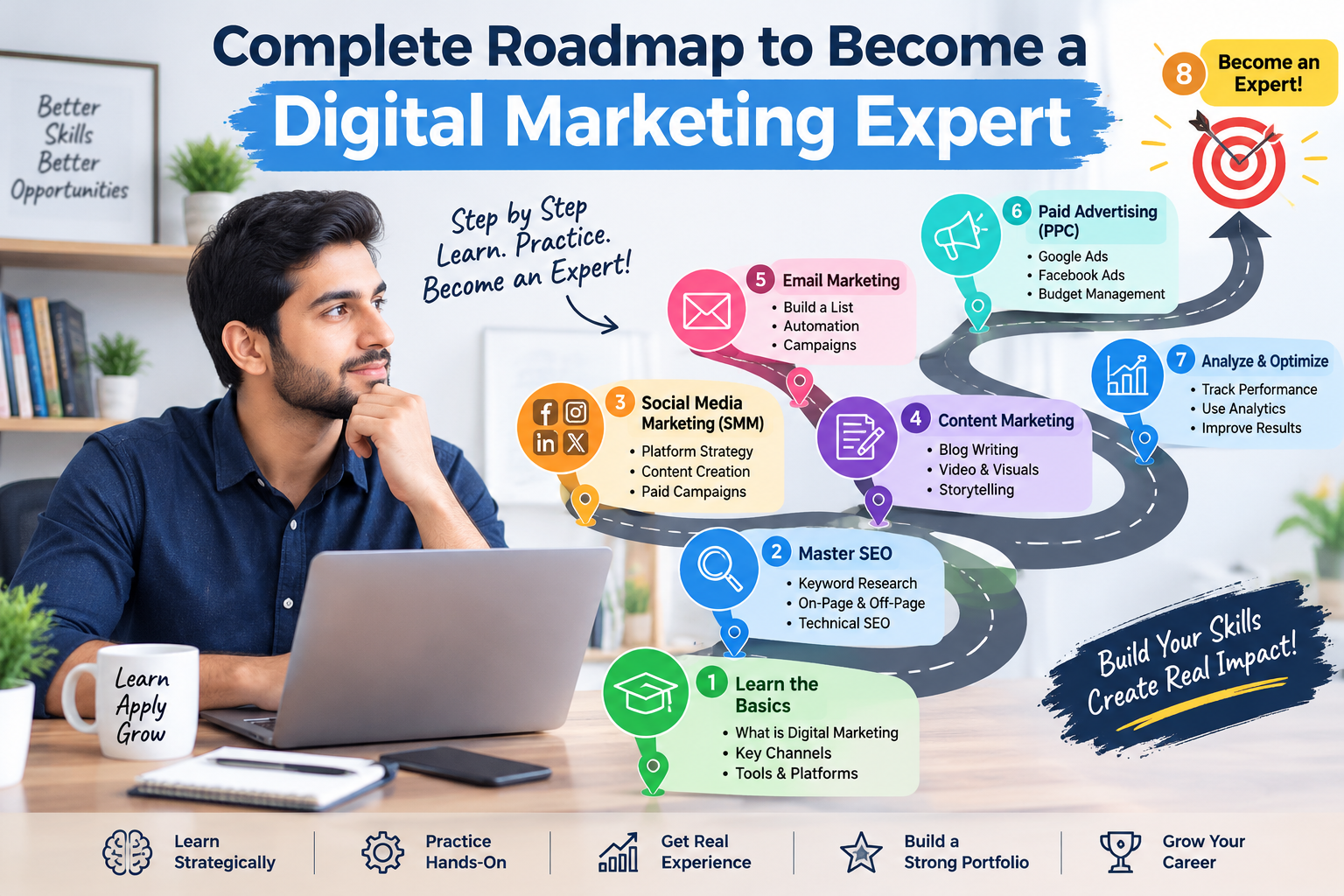
Digital marketing is no longer limited to posting on social media or running advertisements. It combines search engines, content, social media, email, analytics, paid advertising, websites, and customer behavior to help businesses reach the right audience.
If you want to learn how to become a digital marketing expert, the biggest challenge is knowing where to begin. There are many tools, platforms, courses, and marketing strategies available, and trying to learn everything at once can quickly become overwhelming.
A better approach is to follow a structured roadmap.
This guide explains the essential digital marketing skills you should learn, the order in which to develop them, how to gain practical experience, which tools are worth learning, and how to build a career or freelance business around your skills.
What Does a Digital Marketing Expert Do?
A digital marketing expert helps businesses attract, engage, and convert customers through online channels.
Depending on their role, a digital marketer may work on:
- Search engine optimization (SEO)
- Content marketing
- Social media marketing
- Search advertising
- Display advertising
- Email marketing
- Website optimization
- Analytics and reporting
- Conversion optimization
- Online reputation and brand promotion
Not every digital marketer needs to master every area equally.
A beginner should understand the overall digital marketing ecosystem and then develop deeper expertise in one or two areas.
Step 1: Learn the Fundamentals of Marketing
Before learning individual tools, understand the basics of marketing.
A marketer needs to know who the customer is, what problem the product solves, why someone should choose it, and what motivates a person to take action.
Start by learning concepts such as:
- Target audience
- Customer needs
- Buyer journey
- Value proposition
- Brand positioning
- Marketing funnel
- Customer acquisition
- Conversion
- Customer retention
For example, a company selling running shoes does not simply need more website visitors. It needs visitors who are interested in running and are likely to consider purchasing running shoes.
This difference between traffic and relevant traffic is fundamental to digital marketing.
Step 2: Build a Strong SEO Foundation
SEO is one of the most important skills for digital marketers.
Search engine optimization involves improving websites and content so that they can become more visible in relevant search results.
Start with the fundamentals:
Keyword Research
Learn how people search for information, products, and services.
Understand:
- Search intent
- Informational keywords
- Commercial keywords
- Transactional keywords
- Long-tail keywords
- Keyword relevance
Do not select keywords only because they have a high search volume. The keyword should match the website’s audience and business goals.
On-Page SEO
Learn how to optimize elements such as:
- Page titles
- Meta descriptions
- Headings
- URLs
- Internal links
- Image alt text
- Content structure
Technical SEO
Once you understand basic SEO, learn how websites are technically optimized.
Important areas include:
- Website speed
- Mobile usability
- Indexing
- Crawlability
- Structured data
- XML sitemaps
- Canonical URLs
You do not need to become a software engineer to understand technical SEO, but you should know how technical problems can affect search visibility.
Step 3: Learn Content Marketing
SEO and content marketing work closely together.
Content marketing involves creating useful material that attracts and helps a specific audience.
Content can include:
- Blog articles
- Guides
- Videos
- Infographics
- Social media posts
- Case studies
- Newsletters
- Product content
Good content should have a purpose.
Before creating an article, ask:
Who is this for, what problem does it solve, and what should the reader do next?
Learning to answer these questions will make your content more useful than simply producing articles around keywords.
Step 4: Master Social Media Marketing
Social media gives businesses another way to communicate with their audiences.
Instead of trying to master every platform immediately, learn the principles behind social media marketing.
Understand:
- Audience research
- Content planning
- Content calendars
- Engagement
- Short-form video
- Community management
- Social media analytics
- Platform-specific content
Different platforms attract different audiences and content styles.
A successful strategy is therefore not simply copying the same post everywhere. The content should be adapted to the platform and audience.
Step 5: Learn Paid Advertising
Organic marketing can take time. Paid advertising allows businesses to promote products and services to targeted audiences.
Start by learning the basic concepts behind advertising:
- Campaign objectives
- Audience targeting
- Ad creative
- Landing pages
- Budgeting
- Bidding
- Click-through rate
- Conversion rate
- Return on advertising spend
You can then explore platforms such as Google Ads and Meta’s advertising tools.
Do not begin by spending large amounts of money. Learn how campaigns work first and practice with controlled projects or simulations.
The goal is to understand why an advertisement works or fails, rather than simply knowing which buttons to click.
Step 6: Learn Email Marketing
Email remains an important direct communication channel for many businesses.
A digital marketer should understand:
- Email lists
- Segmentation
- Newsletters
- Welcome sequences
- Promotional campaigns
- Subject lines
- Calls to action
- Automation
- Performance measurement
The most important lesson is that effective email marketing is not about sending more emails. It is about sending relevant messages to the right audience at appropriate times.
Step 7: Understand Website and Conversion Optimization
Digital marketing ultimately needs to support a business objective.
Getting visitors to a website is useful, but what happens afterward?
A digital marketer should understand conversion optimization.
This includes examining:
- Landing pages
- Headlines
- Calls to action
- Forms
- Navigation
- Product pages
- Checkout processes
- Trust signals
For example, if an advertising campaign generates visitors but very few people complete the desired action, increasing the advertising budget may not solve the real problem.
The landing page or offer may need improvement.
Step 8: Learn Analytics and Data
Data helps marketers make better decisions.
You should learn how to interpret common metrics such as:
- Website traffic
- Engagement
- Click-through rate
- Conversion rate
- Cost per acquisition
- Customer acquisition cost
- Revenue
- Return on investment
The exact metrics depend on the campaign and business model.
Do not focus on numbers simply because they look impressive. Ask what the metric tells you about customer behavior and whether it supports the business objective.
Tools such as Google Analytics and Google Search Console can help marketers understand website performance and search visibility.
Step 9: Learn the Tools Digital Marketers Use
You do not need to memorize dozens of marketing tools.
Start with a small toolkit and become comfortable using it.
Useful categories include:
SEO Tools
Learn tools that help with:
- Keyword research
- Competitor research
- Website audits
- Search performance
- Backlink analysis
Analytics Tools
Learn how to work with website and campaign analytics.
Content Tools
Become comfortable with tools for:
- Graphic design
- Video editing
- Writing
- Content planning
- Collaboration
Advertising Platforms
Learn the interfaces and reporting systems used by major advertising platforms.
The exact tools can change over time, so focus on understanding the marketing principles behind them rather than becoming dependent on one software product.
Step 10: Practice With Real Projects
This is where many aspiring marketers make a mistake.
They complete course after course but never actually market anything.
Knowledge becomes much more valuable when you apply it.
Create your own practice project.
For example, build a simple website around a topic you understand.
Then:
- Research its audience.
- Identify relevant keywords.
- Create useful content.
- Optimize the pages.
- Promote the content.
- Track performance.
- Analyze the results.
- Improve the strategy.
You can also help a small business, nonprofit, personal brand, or friend with a legitimate project.
The purpose is to create measurable experience that you can eventually demonstrate to employers or clients.
Step 11: Build a Digital Marketing Portfolio
A portfolio helps you demonstrate what you can actually do.
Your portfolio does not need to contain dozens of projects.
A few well-documented projects can be more useful.
For each project, explain:
- The original objective
- The target audience
- Your strategy
- The work you completed
- The tools you used
- What you learned
- The results, if reliable data is available
Avoid inventing impressive-looking results.
If a project did not generate measurable business results, explain what you accomplished instead.
Honest documentation is more valuable than fake success stories.
Step 12: Choose a Specialization
Digital marketing is a broad field.
Once you understand the fundamentals, consider specializing.
Possible paths include:
SEO Specialist
Focus on organic search visibility, technical SEO, content optimization, and search strategy.
Paid Advertising Specialist
Focus on search, social, display, and performance advertising.
Content Marketing Specialist
Focus on content strategy, research, editorial planning, and distribution.
Social Media Specialist
Focus on social content, community growth, campaigns, and platform strategy.
Email Marketing Specialist
Focus on email campaigns, automation, segmentation, and conversion.
Performance Marketer
Focus heavily on measurable acquisition, testing, analytics, and optimization.
Specialization does not mean ignoring everything else. A strong specialist understands how their area connects with the wider marketing system.
Step 13: Learn How to Read a Marketing Brief
Professional marketers rarely receive projects that simply say, “Do SEO.”
A client or employer may provide a business goal instead.
For example:
“We want more qualified customers for our online service.”
Your job is to determine:
- Who the target customers are
- Where they search for information
- What problems they have
- Which channels can reach them
- What content or offer they need
- How success should be measured
This is where strategic thinking becomes more important than simply knowing software.
Step 14: Develop Communication and Business Skills
Technical marketing knowledge is only part of becoming a professional.
You also need to communicate clearly.
Develop skills in:
- Writing professional emails
- Presenting strategies
- Explaining results
- Managing deadlines
- Working with teams
- Understanding client requirements
- Giving and receiving feedback
Freelancers should also understand proposals, contracts, invoices, revisions, and client relationships.
These skills can make a major difference when competing for real opportunities.
Step 15: Keep Learning as Digital Marketing Changes
Digital marketing does not remain static.
Search engines change. Advertising platforms introduce new features. Consumer behavior evolves. New content formats appear. AI tools are changing how marketers research, create, analyze, and optimize campaigns.
That means becoming a digital marketing expert is not about reaching a point where you know everything.
It is about developing the ability to learn, test, measure, and adapt.
Follow official platform documentation, reputable industry publications, professional communities, and reliable educational resources.
Whenever you learn a new tactic, ask whether it actually supports the audience and business objective.
Common Digital Marketing Mistakes to Avoid
Trying to Learn Everything at Once
SEO, paid advertising, content, email, analytics, social media, and conversion optimization are large subjects.
Learn them progressively.
Chasing Every New Trend
Not every new platform or marketing trend is relevant to every business.
A strategy should be based on audience and objectives, not simply popularity.
Focusing Only on Traffic
More visitors do not automatically mean more customers.
Look at the quality of traffic and what users do after arriving.
Ignoring Analytics
Without measurement, it becomes difficult to know whether a campaign is actually working.
Copying Competitors
Competitor research is useful, but copying another brand’s strategy rarely creates a strong long-term advantage.
Study competitors to identify opportunities, then develop your own approach.
A Simple Digital Marketing Learning Roadmap
If you are starting from zero, use this progression:
Stage 1 — Fundamentals
Learn marketing concepts, customer behavior, funnels, positioning, and basic terminology.
Stage 2 — Core Channels
Learn SEO, content marketing, social media, email, and paid advertising.
Stage 3 — Analytics
Learn how to measure traffic, engagement, conversions, and campaign performance.
Stage 4 — Practice
Build your own website, campaign, social account, or other practical project.
Stage 5 — Portfolio
Document your projects and demonstrate your process.
Stage 6 — Specialization
Choose one area where you want deeper expertise.
Stage 7 — Professional Experience
Look for internships, freelance projects, agency work, or in-house marketing roles.
Stage 8 — Continuous Improvement
Keep testing strategies, studying changes, and improving your results.
Key Takeaways
Becoming a digital marketing expert is a process rather than a single course or certification.
Focus on these principles:
- Learn marketing fundamentals before relying on tools.
- Understand SEO and content.
- Learn social media and paid advertising.
- Develop analytics skills.
- Practice with real projects.
- Build a credible portfolio.
- Choose a specialization.
- Improve communication and business skills.
- Measure results instead of relying on assumptions.
- Continue learning as platforms and technology change.
Frequently Asked Questions
There is no fixed timeline because digital marketing covers many different skills. A beginner can learn the fundamentals relatively quickly, but developing professional expertise requires consistent practice and real-world experience. The most effective approach is to learn progressively while working on practical projects rather than relying only on theoretical study.
Yes. A marketing degree is not the only way to enter digital marketing. You can learn through reputable courses, documentation, practical projects, internships, freelance work, and self-directed study. What matters is developing useful skills and being able to demonstrate your knowledge through practical work and results.
Start with marketing fundamentals and audience research before specializing. After that, SEO, content marketing, social media, paid advertising, email marketing, and analytics provide a useful foundation. Once you understand the broader ecosystem, choose one area for deeper specialization based on your interests and career goals.
Digital marketing can provide different career paths, including SEO, content, social media, paid advertising, analytics, email marketing, and performance marketing. Beginners should focus on developing practical skills rather than expecting immediate results. Building a portfolio and gaining hands-on experience can make it easier to demonstrate your abilities.
Understanding AI tools can be useful because they can support research, brainstorming, content workflows, analysis, and other marketing tasks. However, AI does not replace the need for marketing fundamentals, critical thinking, fact-checking, creativity, and strategy. Marketers should learn how to use AI responsibly while maintaining human oversight.
Conclusion
Learning how to become a digital marketing expert requires more than collecting certificates or learning how to operate marketing software.
The strongest digital marketers understand audiences, identify problems, choose appropriate channels, create useful experiences, measure performance, and adjust their strategies based on evidence.
Start with the fundamentals, learn the major marketing channels, practice on real projects, and gradually specialize in an area that interests you.
You do not need to master everything on the first day. Build one skill at a time, apply what you learn, document your work, and keep improving. That process can turn basic digital marketing knowledge into a valuable professional skill.